How to protect enterprise value during CEO succession, founder exits, and business sales
Transitioning a business is more than a financial decision, it’s the moment that reveals whether the organization can perform beyond its current leader or ownership structure.
In my work with founder-led and private-capital-backed companies, one pattern shows up consistently: leadership transitions — whether driven by a CEO exit, founder succession, or the sale of the business — are among the most underestimated risks to enterprise value.
Even the most well-planned transitions introduce friction. Momentum slows. Decisions hesitate. Confidence wavers. And even the strongest successors or new ownership teams can inherit instability before they have a chance to lead.
We call it the “Value Dip”, a business continuity gap that emerges early, compounds quickly, and erodes performance if left unchecked.
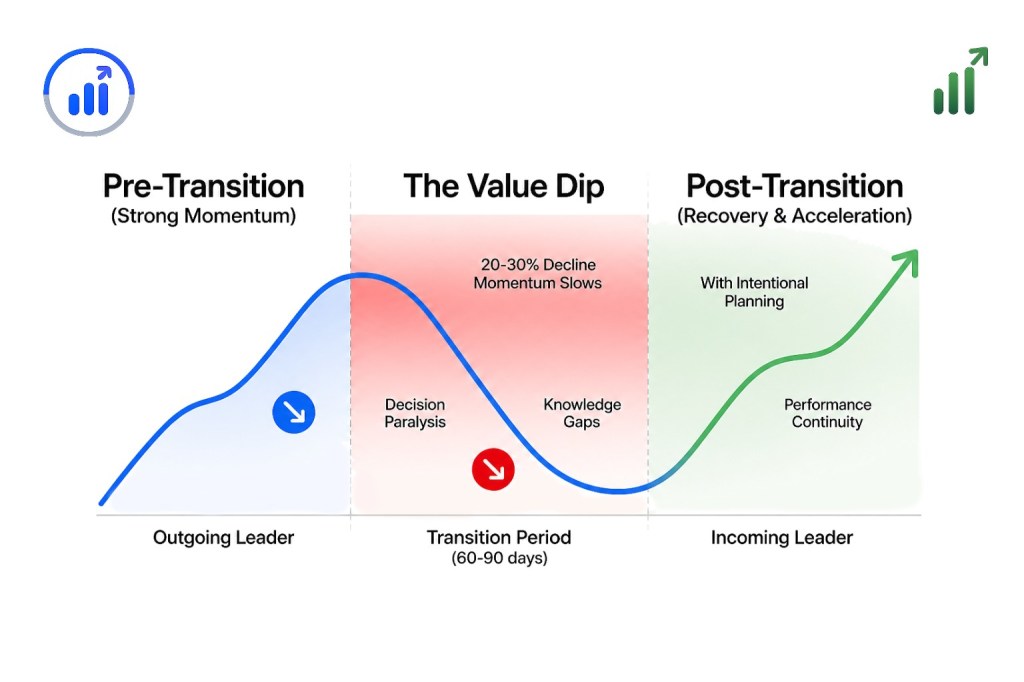
Research from McKinsey & Company, “Passing the baton: Creating value through CEO succession at family businesses” (McKinsey, 2026), and PwC consistently shows that leadership transitions rank among the highest-risk periods for organizational performance, with many companies experiencing double-digit declines, often in the 20–30% range, across productivity, revenue, and retention in the first 6–12 months.
The implication is clear: the Value Dip isn’t a leadership problem, it’s an operating system problem.
When succession or ownership transition is treated as a moment instead of a system, performance breaks. But when it’s anchored to the broader business strategy, protecting continuity and building long-term legacy, the risk fundamentally changes.
The best organizations don’t just manage transitions, they design them to accelerate.
Why the Value Dip Happens
Transitions, whether leadership changes or ownership shifts, create friction at the exact moment when clarity and momentum matter most.
Four forces typically collide:
- Knowledge gaps: Critical, unwritten insight walks out the door or fails to transfer during ownership change.
- Relationship fractures: Hard-earned trust with clients, investors, and teams resets, especially during a sale.
- Decision paralysis: The organization pauses while new leadership or ownership calibrates authority and direction.
- Cultural drift: The “old way” and “new expectations” clash without proper translation.
Left unmanaged, these forces compound quickly, leading to slower execution, eroded confidence, and a measurable hit to enterprise value.
So how do you break this pattern?
From Succession Planning to Performance Continuity
The highest-performing organizations don’t treat succession or ownership transition as an HR event or transaction milestone. They treat it as a core operating discipline directly tied to performance. Here’s what that looks like in practice.
🔷Start Early and Keep It Visible
Succession and transition readiness aren’t last-minute activities. Leading companies maintain a living bench and transition readiness plan for critical roles, aligned with evolving business priorities and potential exit scenarios.
🔷Design the Transition, Don’t Just Announce It
A structured 60–90 day overlap and activation period is essential. Top organizations use a formal Transition Playbook that captures strategic priorities, key relationships, active initiatives, and the unwritten rules that actually drive results, especially critical during a sale or post-close integration.
🔷Anchor on Strategy, Not Just the Seat
Continuity is about protecting momentum, not just replacing a person or changing ownership. Document the “why” behind major decisions and align 30/60/90-day expectations to measurable business outcomes.
🔷Communicate to Stabilize Confidence
Silence breeds speculation, especially during a sale. Clear, consistent communication, internally and externally, maintains trust and reinforces direction during times of uncertainty.
Role-Specific Moves That Protect Value
Strong transitions require clear accountability at every level. Here’s what each key player should focus on.
🧭 For the Board of Directors…
This is governance, not administration. Boards should treat CEO succession and transition readiness as ongoing responsibilities, particularly in the context of a potential sale, while monitoring leading indicators like engagement, retention, and revenue run-rate throughout the transition period.
🤝 For the Outgoing CEO…
Your final act defines your legacy. Prioritize knowledge transfer over control. Co-create the Transition Playbook, ensure continuity of key relationships, and actively support both the incoming leader and, where applicable, the new ownership group.
🚀 For the Incoming CEO…
Your first moves set the trajectory. Listen before you lead. Honor what works. Establish clarity on decision rights, priorities, and operating cadence within the first 30–60 days, while delivering early wins that build credibility across both legacy teams and new stakeholders.
🌱 For the Founder…
Founder transitions, especially in a sale, carry the highest emotional and cultural risk. Reduce dependency early. Develop successors in advance. Codify your vision and values. And be intentional about your post-transition role to avoid becoming a shadow leader.
📈 For Investors and New Ownership Teams…
A successful deal doesn’t guarantee successful performance. Value is won or lost in the first 6–12 months post-close. Align quickly on operating cadence, decision governance, leadership expectations, and cultural integration to avoid unintended disruption.
Real-World Payoff
When succession is designed for continuity and legacy, the results are transformative.
The incoming leader, or ownership team, spends less time stabilizing and more time building. Institutional knowledge stays intact. Credibility accelerates. Fresh perspective shows up without breaking momentum.
In the best cases, transitions become inflection points, not interruptions. Leadership and ownership transitions don’t have to come at the cost of performance.
But that requires a fundamental shift: Stop treating succession and business transition as isolated events. Start treating them as operating system decisions—intentionally aligned to strategy, continuity, and long-term legacy.
If you’re a CEO, founder, board member, or investor, ask yourself: If your top leader stepped out, or your business changed hands, tomorrow, would performance hold, or would it dip?
If the answer isn’t clear, that’s the signal. The time to design for continuity is now, before disruption forces your hand.
And if you’re navigating a transition, preparing for a sale, or pressure-testing your organization’s readiness, this is exactly where we partner with leadership and investment teams at Vantyx, helping protect enterprise value and sustain performance through critical inflection points.

